
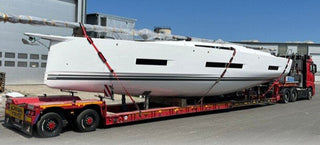
 Our brand-new Hanse 510 “Tropea” in all its glory, before setting sail for Slovenia from the Hanse Werft in Greifswald.
Finally, soon on the water: Our dream von our own sailing yacht is coming true!

With my heart pounding and tears in my eyes, I stare at the production photos of our new Lagoo sailing yacht. I still can hardly believe it, that our dream of having our own school yacht is coming true! The quality check is currently underway, and the final little jobs are being completed.

Our new Hanse 510 created in the configurator. Over 2 years ago. The black GRP steering wheels simply had to be. Instead of the conventional steel wheels.
But be careful, euphoria aside: I know, that the road from the production site to the open sea is still long. The yacht still has to be accepted, and who knows, what little or big surprises await us. Was the configuration correct? Were all our wishes taken into account? Does everything work perfectly?
After all, every ship is unique, with its own strengths and weaknesses. Even though many components are standardized, every detail matters. A sailing yacht has many more individual parts than a motor yacht. This makes it much more complicated and prone to errors. But the difference is worth it...😊
But the anticipation outweighs it: In a few weeks, our Hanse 510 will finally be on the water and ready for unforgettable adventures. In our blog, I will take you along on our journey to the maiden voyage.
Together we will explore the advantages of our new sailing yacht: Why is it the perfect choice for our offshore school and training and mile-end trips?
Let yourself be infected by the enthusiasm and look forward with us to the new possibilities that our own sailing yacht opens up for us!

Hardly any sailing yacht in the 51-foot class offers more windows and ventilation options. The salon is therefore flooded with light. The deck is almost completely open. All hatches are flush-mounted. We decided on teak as a design element on the superstructure. On the foredeck, this alone would have cost at least 4x more, so we left it. We didn't want a GRP desert either.
After far over 2 years of planning, organization, coordination, negotiations, and financing, our dream of our own school yacht in Croatia is becoming tangible. Of course, as always, our sailing yacht will also experience a sporty sprint at the end. The boat is still being diligently worked on, so that on June 13, it will go by low-loader and special transport from Greifswald in East Germany to Slovenia and Croatia on the Mediterranean, where the keel will then be connected to the boat for the first time, as well as the rig set up on deck and many other features installed on site, before the yacht is then transferred to Split under its own keel. We will update on this in due course.
What makes our Hanse 510 the ideal sailing yacht for our offshore school or training and mile-end trips?

Modern voluminous hull with spectacular looks for fast and safe sailing from the renowned yacht design firm Berret-Racoupeau.
Is there even an ideal yacht? I don't think so. A yacht is always a compromise between price, performance, and performance. These aspects face each other in a triangle. Many more factors come into play, to name just a few: Personal taste/preferences, priorities, cost-effectiveness, focus, etc. So it is much more a question of where you want to make compromises or have to. But what makes our own Hanse 510 the ideal or optimal sailing yacht for our offshore school and offshore training and continuing education?
The concept is relatively simple and is entirely focused on the focus or needs of our participants. Here are a few questions that are practically self-explanatory:
- Do sailing and offshore students or charter guests
- want to learn and sail on old, dilapidated sailing yachts or on the most modern and best of their class?
- want to sail/learn on complicated sailing yachts?
- prefer a slow turtle or rather Easy Sailing and Fast Cruising?
- a sailing yacht that heels enormously even in the slightest breeze and has to be reefed, or rather a sailing yacht with extraordinarily good balance and stability, that sails stiff and upright?
- prefer hectic and shouting on deck or relaxed, structured docking and undocking maneuvers thanks to the right features in the right place, which are simply missing on normal charter sailing yachts?
- want to do without spaciousness and comfort?
- always have to save electricity, because otherwise the batteries will run out?
- want to wash up yourself after long sailing days?
- store the dinghy on deck or rather at water level in its own garage at the stern?
- a sailing yacht that conveys no driving feel and feedback and feels like a bus, or rather a sailing yacht that is sporty and dynamic, easy to steer with 3 fingers, and conveys unforgettable emotions?
- a sailing yacht that is hardly maneuverable in the harbor and marina because of a twin rudder system, or a sailing yacht that can be steered precisely and sensitively because of a single rudder?
- the important control elements distributed on deck or all gathered at the helm station?
- when staying overnight on board, sleep in the resonance body of a guitar where every little noise is transmitted and amplified, or a well-insulated boat that dampens noises and ensures a soothing, quiet sleep?
I could go on forever with the list of relevant questions or aspects, but if half the readers haven't already dropped out, I should now move on to the next chapter.

Interior fitted out in light European oak. Kitchen counter with real mineral stone for durability. To match this, an uncomplicated dark floor. We decided against a second refrigerator in the kitchen, as we assume that most will rather want to enjoy the culinary highlights of Croatian cuisine in a konoba than always cook themselves, but a dishwasher had to be included. It is quite practical, especially on training and mile-end trips and in holiday mode. It is to the right of the oven. A corresponding alternator (generator) with really a lot of power is also on board, so that electricity can be produced as needed and nothing has to be done without. Finally, we have installed an air conditioning system. I know, I also resisted it at the beginning. But the boats turn into heaters in the summer at the Mediterranean and into damp, cold caves in spring and autumn. Do you want to live and sleep in them? Of course not. The advantages convinced me. And one should also think of all the many electronic gadgets that we now carry with us on vacation. The pantry is practically finished with all the installations.

Master cabin with a generous island bed as well as its own separate shower and toilet for ultimate comfort. Yes, the boat is an owner's version. That had to be. After all, we don't want to serve the masses, but work with small, exclusive groups. Less is more. But will the math work out? We will find out. I hope so, of course. Still in the fitting out.

At the aft double cabin, they are obviously still working, but it is practically finished in essence. Sure, the mattresses will be the last things to come on board, when no more craftsmen are going in and out. We don't see the toilets now. They are of course electric. That means flush at the push of a button.
 Configuration of the interior of our Hanse 510. Skipper's cabin at the very front of the bow with its own entrance/hatch and above all used as storage space. Master cabin in the bow area with its own separate toilet and shower. Salon in the middle. Toilet and shower on port as well as bunk cabin on starboard. Two identical double cabins in the stern. We decided against an additional toilet/shower in favor of the Pullman double berth. The idea is that the guests will stay in spacious, comfortable double berths.
Why buy our own offshore sailing yacht for our offshore school and training & mile-end trips?
In other words, we first asked ourselves fundamental questions about what needs aspiring and existing offshore skippers might have or should have. In the search for such sailing yachts, in the right area and with exactly the right combination/features, we noticed how difficult it is to find such yachts and/or charter them at affordable prices. It is actually understandable. The standard charter yachts that the average consumer charters have to be profitable and are equipped with the absolute minimum. If the purchase price of a yacht is too high, the return on investment goes down the drain as well as the return on investment. With the slow turtles as well as minimally equipped sailing yachts that you can charter, we did not want to make friends with them due to our demands. I don't do this privately and especially not in the professional field. So we had to get creative. In the end, our own offshore yacht for our training and mile-end trips as well as for charter guests will soon be ready. I hope we have done our job correctly and thought of everything. If relevant features are missing, we will of course make improvements. The advantage is obvious. We were able to look at and evaluate all the brands that were in question. Compare them. Create a short list and finally decide which one it would be. In addition, we were able to fully equip our sailing yacht according to our wishes and needs or our customers and partners. Sure, that has its price. And not a small one. But we believe it is worth it. Our customers and partners will appreciate the difference and in the end it will be a classic win/win situation for everyone. Everyone should benefit. That is the goal. We have been successfully pursuing the exact same philosophy on Lake Zurich for years. In a short time, we have established ourselves with our concept as the largest sailing school on Lake Zurich. We want to expand this success model above all for our existing students/customers as well as those of our partner Hochsee.Schule and those who are satisfied with us/were satisfied and like our philosophy, so that they can continue with us on the high seas in the usual quality.

Command center: On the left of the image, the largest chart plotter we could install and the latest technology from B&G. In the middle, the covered autopilot from Yanmar as well as the control for the retractable bow thruster. The 3 buttons at the bottom right are for operating the two electric winches as well as for lowering or raising the cockpit table. And last but not least, the most important tool for harbor and docking maneuvers and missing from all normal charter yachts; the electronically controlled throttle and engine control on the helm station. You can hardly believe it, otherwise it is installed on the side on the floor! The placement of the throttle might amaze some experienced offshore skippers and cause great relief, as it is absolutely not standard. This costs something. But is it important? Yes, very! For the active sailor, there are even more instruments/indicators on the side of the helm stations. And of course, this configuration is mirrored redundantly on both steering columns.

A regatta yacht would be configured completely differently. Winches distributed all over the deck. Mostly also on the lower deck. The only downside is who wants to get into or out of the boat when work is currently being done on deck. And no, we don't want to take our school boat to the racetrack. Quite the opposite, we decided on single-handed suitability. Apart from that, our Hanse 510 is a very fast boat and one of the fastest ever in its class. All sheets and halyards are led all the way to the back, within reach of the helmsman - invisibly - in corresponding lockers, so that no lines disturb the cockpit. This is practical, convenient, and safe. Apart from that, it also looks really cool. ✌️Both winches are at the helm station/helmsman. Together with the self-steering jib, our new Hanse 510 is absolutely single-handed suitable and fully corresponds to the DNA of Hanse. Easy Fast Cruising, as Hanse itself calls it.

The designer probably wanted to make a statement with the negative wave-piercer bow and show off the potential of the ship a bit. No question, the Hanse 510 looks spectacularly modern and is an eye-catcher in the harbors and marinas.

Despite the underpowered conventional sail plan with only 125.5 m2 Amwind sail package, the boat is very fast for a cruiser. In the lower wind range, the ship makes approx. 75% of the wind speed, in the upper approx. 50%, up to the hull speed, which lies just below and above the double-digit range. So between 9.5 and 12 knots. And the cool thing about it is that such speeds are easily reached without much effort and a spinnaker. That really sweeps. 😎 This underpowered rig, stiffness of the hull as well as the deep L-keel make the Hanse 510 a stable sailing cruiser that can be maneuvered on the lake like on rails. Easy Fast Cruising, indeed. Most - regardless of age group - then often use the slightly obscene word that starts with G... to express their feeling of happiness. We love it. And everyone, all those we have been able to experience on the boat so far, obviously too.

You can't see much of the engine now because of the wooden panel. If any motor yacht freaks happen to have stumbled upon this blog, this will surely be nothing spectacular for them. A proven Yanmar diesel sail drive with 80 hp is installed and is typically located under the companionway at the center of gravity or center of mass. The power is definitely sufficient for the boat as well as for driving the alternator. Important detail: We have, of course, opted for a three-blade folding propeller, for significantly less friction and thus easily 0.5 - 1.0 knots more speed under sail. The throttle response might be a bit slower under power. We'll see. Folding propellers on charter yachts: nowhere to be seen. Reason: More expensive to purchase and more maintenance-intensive.
So the dream of owning a boat is coming true! In a few weeks, our new Hanse 510 will finally be on the water and ready for joint training and unforgettable moments on the water in Croatia. We are really looking forward to our new boat and, above all, to sharing it with you on training and mile-building cruises or on charter! We hope that it will ultimately be the perfect choice for you and our offshore school.
PS. Friends & Family (also everyone who has completed their sailing certificate D course with us and all customers of the offshore school) get an additional 10 - 20% special discount on top of the official charter rates and discounts!
We think that the Hanse 510 offers everything or almost everything we want from an ideal sailing yacht: modern design, comfortable equipment, high safety and excellent handling characteristics. With its numerous features and extras, it is perfectly suited for your and our requirements.
But this is just the beginning! We still have many more plans for our new sailing yacht and in Croatia. But we are not revealing that here yet. Everything in its own time. 😎
We would like to thank everyone who has supported us with this project. Without you, it would not have been possible, to make this dream come true.
To be continued...
-
In the next blog posts, I will keep you updated on the further progress. Next up is
- Completing all unfinished details
- Completion of the quality check
- Loading and transport to Slovenia/Croatia
- Assembling the keel as well as the rig
- Installing the final features
- Delivery to Split
- Contact us if you have any questions or suggestions, or leave a comment in the comment field below. We will, of course, be happy to hear from you!
Fair winds and see you soon...