
This article is intended to show you the most important differences between an intensive sailing certificate course and conventional/classic sailing courses. It provides important facts/information as well as advantages and disadvantages. If you are interested in an intensive sailing certificate course, this article will certainly be helpful in understanding whether it is right for you.
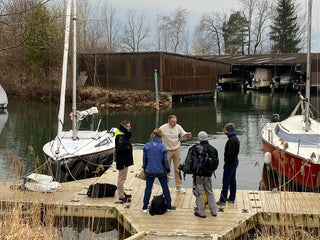
 Image: Intensive sailing certificate course end of March 2022 | Evening sailing back to the harbour at 4 knots (with reefed mainsail) after a fulfilling day of sailing course.
What can you generally expect from good sailing training?
The goals of good basic sailing training - regardless of whether intensive or conventional/traditional:
-
Learning to sail (in random/unordered order)
- All wind courses
- Leading a crew (structured and with commands)
- Man overboard manoeuvre
- Man overboard to buoy manoeuvre
- Preparation before departure
- Safe mooring and departure
- Setting, furling, and reefing sails
- Clearing the ship
-
Weather knowledge
- Forecasts
- Observation
- Interpretation
-
Most important rules
- Right of way
- Distances
- Speeds
- Shore zones
- Signals
-
Seamanship means;
- Knowledge & skills/abilities for the practical and safe handling of a sailboat
- All relevant nautical knots
-
All relevant terms for a sailboat
- Hull
- Sails
- Standing rigging
- Running rigging
-
Safety:
- Fire on board
- Water on board
- Anchoring
- Cross bearing
- Bearing by range
- Nautical chart
- Mobile tools
-
Sailing in different weather conditions
- Wind
- Weather
- Area (different zones of a body of water)
-
Mooring and departure manoeuvres
- in different situations
- Marinas
- Harbours
- Safety & responsibility awareness
- Practical experience on a sailboat
- *Passing the practical exam for the Swiss sailing certificate Cat. D
 Image: Easter intensive sailing certificate course April 2022 | Concentrated course sailing in the best sailing conditions.
Sailing training (sailing course) is a great way to acquire the skills and knowledge to handle a sailboat safely and effectively. The training usually includes wind courses, leading a crew, man overboard, and man overboard to buoy. In addition to the relevant theoretical aspects of the training, participants also learn how to sail in different weather conditions, perform mooring and departure manoeuvres in various situations, and navigate in marinas and harbours. Safety and responsibility awareness are always at the forefront. At the end of the training, participants should be able to lead a sailboat safely and effectively. *The practical exam for obtaining the Swiss sailing certificate Cat. D is not the goal/focus and/or included in many courses.
What are the most important differences between a conventional sailing course and an intensive sailing certificate course?
- Duration
- Intensity
- Flow
- Focus
- Transparency
- Flexibility
- Preparation
The goals and outcomes are more similar than you might think. But the path to get there could hardly be more different. There are 7 particularly relevant differences that we would like to introduce to you in this article.
-
Duration: A classic sailing course usually lasts several weeks/months. An intensive sailing certificate course is like a boot camp and lasts 4 days at the Lagoo Sailing School. Do conventional sailing courses have more lessons than intensive sailing certificate courses? No, absolutely not. Don't be fooled by the long duration of traditional sailing courses. In the end, the number of effective lessons is in the same range and quite comparable, only that in intensive courses they take place compactly in one go.
-
Intensity: The pace and style of an intensive sailing certificate course is sporty (comparable to a boot camp). The learning curve is correspondingly steep. A classic sailing course, by contrast, is leisurely/slow-paced and everything happens much more slowly.
-
Flow: One cannot really speak of a learning flow in the true sense with a conventional sailing course, as the course sets are spread over a few lessons to many weeks/months, and at the beginning of each lesson, what was last learned must be extensively repeated. By contrast, flow is an important feature of an intensive sailing certificate course, as learning and sailing take place without interruption. The structure is based on continuous repetition, similar to martial arts training.
-
Focus: The focus of an intensive sailing certificate course is clearly on learning knowledge and acquiring skills to lead a sailboat and thus pass the exam for the Swiss sailing certificate Cat. D (practical exam). This is not necessarily the case with classic sailing courses. In many traditional sailing courses, it is often simply about learning to sail, without explicit ambitions to obtain the Swiss sailing certificate.
-
Transparency: Many sailing courses are often offered as "driving lessons". Then the offer model is clear and transparent. Clear statement = fair deal. Many sailing training programs are offered as courses, but in practice, they are handled like "driving lessons" by sailing schools. This means that participants of such courses have no guarantee at the end of the course of their actual chances of success in passing the practical sailing exam. Nor do they have any guarantee whether they will even be allowed to take the practical exam at the end of the course (this is often decided by the sailing instructor). Nor do they have any guarantee about the actual duration and costs of the sailing training. Maybe it is just good intentions from such sailing schools? Or simply a good business model? Or maybe a bit of both? The danger and responsibility in sailing is no less and no greater than in comparison to driving a car. A good sailing certificate course - whether intensive/short over several days in a row or in bite-sized pieces over several weeks/months - prepares you in a fun and encouraging way for the sailing certificate exam and is designed as a basic training. Clearly focused on passing the practical sailing certificate exam and structured. With transparent services (promises), prices, and duration.
-
Flexibility: Classic sailing courses are often stubbornly carried out "according to the timetable". Without consideration, replacement, or repetition, if there is no wind or not enough wind to sail. How are you supposed to learn to sail efficiently then? In a good intensive sailing certificate course, you can assume that it is taken for granted that if there is too little or no wind, the course is designed accordingly flexibly and dynamically. In the worst case, it is canceled, postponed, and/or repeated.
- Preparation: A sound theoretical preparation before a sailing course is crucial for the learning success and progress of sailing students. In an intensive sailing certificate course, you must prepare yourself with the relevant theory before the start of the practical course. Your commitment must be higher than in a conventional course, where you have more time to learn. In a high-quality intensive sailing certificate course, you can assume that the sailing school will actively accompany you in this learning process weeks before the start of the practical intensive course and prepare you intensively with free theory courses. Making an intensive sailing certificate course fun, encouraging, and ultimately successful for participants requires a lot of knowledge, know-how, experience, investments, and resources. Without the latest infrastructure, methods, didactics, as well as modern tools and excellent materials, it is not possible either. However, you can expect all of this from a high-quality intensive sailing certificate course. Classic sailing schools teach the theory only in the practical course. You and they also have much more time to learn everything.
 Image: Easter intensive sailing certificate course April 2022 | Concentrated course sailing in the best sailing conditions.
Advantages and disadvantages of the different course types (conventional vs. intensive)
I think it is especially a matter of taste as well as type. Both approaches have advantages and disadvantages.
-
Duration: What are the advantages or disadvantages of a traditional sailing course that lasts for weeks/months? One of the biggest advantages is certainly that students of such courses have more time to let the knowledge and exercises of the individual lessons sink in as well as more time to learn the theory. The time commitment is overall greater and over a longer period. Accordingly, the learning curve is flat. People who prefer to take it easy are well advised with a classic sailing course. It can be both an advantage and a disadvantage that you only learn to sail in small bites every week over a longer period. In such a course, the dynamics, variance, flow (connections, flow), as well as flexibility like in an intensive course can never arise. The intensive course, by contrast, lasts only a few days and is in one go. At Lagoo, usually from Friday to Monday. Such a course is not for nothing called "Intensive" and accordingly requires more commitment/preparation from the participants and full commitment and concentration during the course. That you learn to sail for several days without interruption (practical & theoretical) offers many advantages and is similar to a boot camp. Accordingly steep is the learning curve for this as well as the condensation of what was learned through the many repetitions, within a short time. Everything happens much faster and is more dynamic. For people who want to make sporty and fast progress with their sailing training and are resilient, an intensive sailing certificate course is a fine thing.
-
Pace: Fortunately, intensive courses are carried out in groups of 3 - 4 participants. This ensures optimal rotation. All processes are learned evenly at every station. Students will have the opportunity to process what was learned again and again, to optimize/improve. Many/frequent repetitions of processes/manoeuvres and also the theory are important components of learning success and for the condensation of the learned skills. The pace of a conventional sailing course is slow and leisurely. Maybe cozy?
-
Focus and transparency: In a good intensive sailing certificate course, the focus/orientation should be crystal clear and offer no room for interpretation. Unfortunately, this is not necessarily the case with some traditional sailing courses. Pay attention! Study the offers carefully, compare, and in case of doubt contact the sailing school to get a better feeling.
-
Flexibility: Before you definitely book a sailing course, you should have clarified whether the course will be stubbornly carried out according to the timetable or not in case of too little wind or completely missing wind. A good compromise should be found for everyone involved. The sailing school must be able to assess whether postponing and/or repeating missed lessons (due to, too little or no wind) is necessary for the quality of the training/course and should proactively offer practical/acceptable solutions. You can expect this from a high-quality intensive sailing certificate course, but unfortunately not from all conventional sailing courses. Pay attention! Study the offers carefully, compare, and in case of doubt contact the sailing school to get a better feeling.
-
Preparation: In the intensive sailing certificate course, you absolutely must prepare yourself with theory before the course, because learning goes much faster and you should start the practical course with prior knowledge. In traditional sailing courses, you can start without theoretical preparation, because there is enough time to learn all theoretical aspects during the course. However, prior knowledge is missing because of this.
- Theory: The theory mentioned in this article refers to the theory relevant for the Practical Course as well as the seamanship theory relevant for the Practical Exam, and not the theory for the Theory Exam. Even though there are some minor overlaps (minimum equipment, right-of-way rules, shore zones, sea marks), etc.
 Image: Easter Intensive Sailing Certificate Course April 2022 | Concentrated course sailing in the best sailing conditions under the guidance of our sailing instructor.
Conclusion: Which is better, conventional/traditional sailing courses or modern intensive sailing certificate courses?
By reading this article, you will surely have noticed which model my heart beats for. This is certainly because I myself am convinced by the intensive course model and offer courses in this area myself. This corresponds to my type and my conviction. I myself started out quite conventionally and also took a conventional sailing course at the beginning of my sailing career, like most people. At the Lagoo Sailing School, we have some course participants who have already been in conventional courses and then join our intensive course and pass the sailing certificate exam with fun and flair. The many positive feedbacks, compliments, and results confirm my conviction. Regarding quality and sustainability, I have so far been unable to make any differences between the two approaches. One might think that a longer conventional sailing course is better for long-term memory than a 4-day intensive sailing certificate course, but not even this assumption seems to be true and is refuted in practice by contrary experience. This leads me to the conviction that it does not matter whether you complete a conventional or unconventional intensive course. What counts is your type, taste, goal, quality, and result. Neither one nor the other is right or wrong. In the end, it just has to suit your nature/type. The important thing is that you understand what you want and what you don't, what suits you, and that you search, compare, and choose the right one for you.
 Image: Private Course March 2022 | At the dock after course days with strong winds, rain, and snow | Happy after passing the Practical Sailing Certificate Exam.
By now, at the end of this article, you should have figured out what is right for you. Because by now at the latest, you will either be put off by the concept of the intensive sailing certificate course or you will have fallen in love with the idea (the concept), because it suits your nature. One way or another, it is important that you stay true to yourself and act and live accordingly. If this article was able to answer your most important/urgent questions about the difference between intensive sailing certificate courses and traditional sailing courses, then I am happy to have made a contribution to your decision-making.
Ship ahoy and warm regards...Ivano