
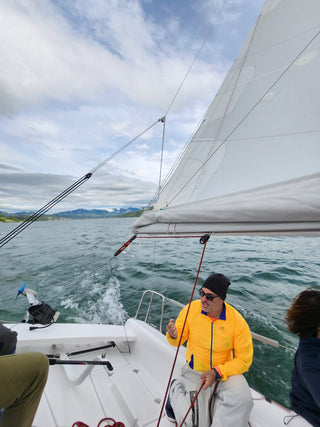
Sailing captivates with freedom and adventure, but safety is key. The tack and Q-tack are essential manoeuvres for changing your course safely. While the tack is a standard method, the Q-tack is a safe alternative to gybing – especially during a man overboard manoeuvre. In this article, you will learn everything you need to know for your sailing course to obtain your sailing certificate. Start now with Lagoo, the top sailing school on Lake Zurich!
What is a tack in sailing?
A tack is a basic manoeuvre to turn your boat through the wind with the bow. It is safer than gybing, where the stern goes through the wind, and is practised in every sailing course.
Why the tack is important
- Safety: Avoids risks such as uncontrolled gybes in strong winds.
- Tacking: Enables zigzag sailing against the wind (close-hauled course).
- Sailing exam: Mandatory for the sailing certificate (e.g. Swiss boat licence Cat. D).
Step-by-step tacking procedure
- Preparation: Call "Ready to tack!" and prepare the sheets.
- Heading up: Turn the boat slowly into the wind until the bow goes through.
- Changing the jib: The jib trimmer calls "Jib falling", you call "Jib across" and the jib trimmer brings the forward sail to the other/new (lee) side.
- Adjusting the mainsail: The mainsail adjusts automatically as it is fully sheeted.
- Completion: Call "New close-hauled course set" and sail on the new course.
Tip: Practise the tack in a sailing course at Lagoo in Zurich to perfect it!
The Q-tack: Your alternative to gybing
The Q-tack (also known as an alternative to the quick-stop) is an extended tack that offers a safe alternative to gybing. A Q-tack is performed when the tacking angle is greater than that from close-hauled to close-hauled or beam-to-beam. For example, from reaching to reaching, which theoretically amounts to 180°, but due to leeway is usually 200–220°. In the upper wind sector (close-hauled), it is a completely normal tack and the process is correspondingly the same. So instead of turning the stern through the wind, you head up until the boat makes a Q-shaped loop.
Advantages of the Q-tack
- Safety: No risk of a broach in strong winds.
- Simplicity: Easier for beginners in sailing courses.
- Flexibility: Ideal in waves or strong winds, where gybing would be dangerous.
- Gybing alternative: Turns the boat safely by 180° or more.
- Learning to gybe: At Lagoo, you learn to gybe in a structured and safe manner.
Q-tack procedure
- Start: Head up from a room-wind course (wind from astern) to a beam-wind course.
- Tacking: Continue heading up until the bow goes through the wind.
- Q-shape: The boat makes a Q-shaped (or figure-8) loop.
- Completion: Adjust the sheets and sail on the new course.
Tip: Wear life jackets and coordinate the crew. Learn the Q-tack simply – because it is structured – at a sailing school like Lagoo!
Q-tack in a man overboard manoeuvre
The man overboard manoeuvre (MOB) is a rescue manoeuvre in which the Q-tack is central. It stops the boat quickly and enables a safe return to the person in the water. The goal is to reach them within 2 minutes after the person has gone overboard. Apart from that, a good skipper ensures that no one ever goes overboard in the first place.
Why the Q-tack is crucial in the MOB manoeuvre
- Speed: Fast manoeuvre in all wind conditions and independent of crew size.
- Safety: Avoids a risky gybe.
- Exam standard: Must-have manoeuvre for the offshore certificate and sailing exam.
MOB manoeuvre procedure with Q-tack
- Alarm: Call "Man overboard!" or "Person overboard!", "Throw rescue equipment, indicate position and distance!" (e.g. lifebuoy and MOB buoy, if available).
- Head up or fall off to a beam-wind course.
- Sail away for 3–4 boat lengths.
- Initiate the Q-tack: Head up to a close-hauled course, then tack.
- Sail back towards the person with a turn to bring them alongside (2–3 boat lengths)
- Call "Prepare the boat hook!"
- Almost alongside: Call "Shoot, sheets go!"
- Rescue: Row towards the person, if necessary, put the mainsail aback, call "Mainsail aback!" .
- Completion: Take the person or, in a simulation, the buoy into the boat at your level.
Tip: The MOB manoeuvre at Lagoo is a showcase discipline that we practise and perform with precision and fun, and we can perform it exactly the same way on the open sea as our participants do during their offshore training, providing a very solid foundation. Practise the MOB manoeuvre in a sailing course at Lagoo for your sailing certificate!
Safety tips for tacking and the Q-tack
- Beginners: Practise in calm water and light winds.
- Safety: Wear life jackets and coordinate the crew.
- Avoid mistakes: Do not head up too abruptly and stay calm.
- Extension: Train for the offshore certificate at Lagoo on Lake Zurich.
Conclusion: Master the tack and Q-tack with Lagoo
The tack and Q-tack are essential for safe sailing. As an alternative to gybing and the core of the man overboard manoeuvre, they are mandatory in every sailing course. Sign up at Lagoo in Zurich and start your sailing certificate!
Call-to-Action: Book your sailing course at Lagoo now and experience the sailing adventure on Lake Zurich!